The New Supply Chain Technology Equation: Q&A with RFgen’s Hardware and Partner Experts
AI, automation, ERP modernization, and connected technologies are changing the way organizations think about their supply chain technology stack. As these systems become more interconnected, technologies that once sat quietly in the background, from hardware and labeling to mobile data capture, are playing a larger role in data quality, scalability, and supply chain innovation.
For customers, that means building a technology environment that can solve today’s challenges while adapting to what comes next. For systems integrators, hardware providers, and other technology partners, it creates an opportunity to look beyond the immediate product request, solve broader customer challenges, and build longer-term relationships.
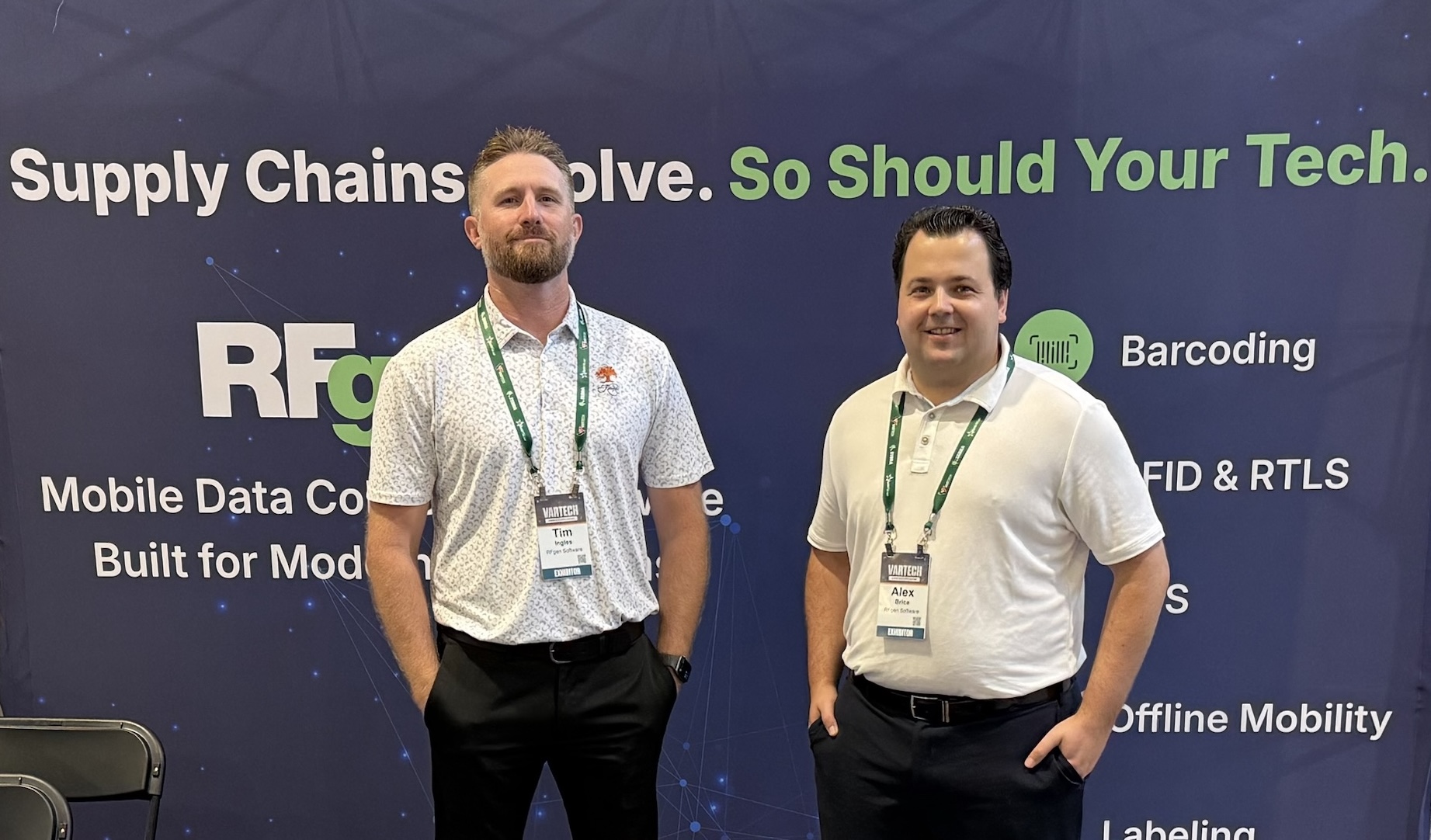
We sat down with Alex Brice, Manager of Partnerships at RFgen, and Tim Ingles, Manager of Hardware Sales at RFgen, to discuss what they’re seeing in the market, why these often-overlooked technologies matter, how they fit into the future of supply chain innovation, and how customers and partners can create more value through a connected approach.
A More Connected Supply Chain Technology Market
Looking across the supply chain technology market, what changes are having the biggest impact on customer priorities and technology decisions right now?
Alex: What I’m seeing is that customers are thinking less about individual products and more about how the technology fits into the broader operation. Things like ERP modernization, automation, and AI are really forcing companies to prioritize data quality and flexibility throughout their operation. They’re also putting more emphasis on long-term fit. The investments customers make today need to support where they want to be three to five years from now.
Tim: From an AI perspective, customers are starting to expect everything immediately. They see what AI can do right out of the gate when you ask it a question or tell it to do something for you. It may not be an immediate expectation from every customer quite yet, but I can see it trending in that direction based on how quickly AI responds and creates. Building that into a software development platform is going to be a huge benefit.
Are customers becoming more focused on how these technologies work together?
Alex: The modern supply chain really depends on information moving between physical operations and the enterprise. Every disconnected system creates another opportunity for manual work, duplicate entry, or inaccurate data. Especially with ERP and cloud modernization, those gaps are becoming increasingly visible. That’s pushing companies toward solutions that work together instead of adding another isolated system that has to be connected and maintained separately.
How is that changing what customers expect from their technology partners?
Alex: Customers are expecting a lot more from partners and software providers in general. They’re asking partners to understand more of their operation and help them make better technology decisions across it. That creates an opportunity for partners to become trusted advisors. They can understand how to connect the hardware to the software, the workflows, and the ERP system rather than solely focusing on one product.
I’m also seeing a lot of partners working with three or four different companies on one opportunity. They have groups of people they like to work with because it’s really about understanding the whole operation and all the problems associated with it.
Tim: If partners are only handling individual hardware or software transactions, they’re missing the broader operational challenges. Customers are looking for someone who can help with the software, hardware, label printing, and the other pieces they need across that environment. They want a single point of contact for orders, consulting, support, hardware repairs, or whatever else they need.
Where is the biggest opportunity for partners to add more value to the customer and take on that broader role?
Alex: I think it’s important to start with the workflow instead of the product. When a customer comes to you for a printer or scanner, there’s always something else going on behind the purchase. You really have to dig into what the actual problem is. Our partners need to be thinking about that every time they approach an opportunity.
The more you understand the customer’s operation and where they’re headed, the more opportunities you have to help them along the way. Partners can move from responding to individual purchases toward understanding the customer’s operational roadmap. Knowing where those customers are expanding or modernizing creates opportunities to proactively solve problems over a much longer relationship.
Connecting Technology to the Data Foundation
When organizations think about building a strong data foundation, what tends to get overlooked about the technologies closest to where the work happens?
Tim: They sometimes overlook the simplest technology that can solve the problem. More advanced technology doesn’t automatically deliver better ROI or a more streamlined workflow.
Alex: That’s where understanding the broader operation becomes important. Customers need technology that can support where they are today, but also new facilities, workflows, ERP changes, or other technologies they may introduce over time. The strongest solutions are the ones customers can keep building on as their operation changes. It’s about having flexibility across the technology ecosystem. The software needs to work effectively within that operational environment while giving customers room to introduce new hardware and technologies as their requirements change.
Hardware and labeling aren’t always viewed as strategic technologies. What role do they actually play in the accuracy and reliability of operational data?
Alex: The quality of your operational data starts at the point where the physical product gets identified and the transaction gets captured. Hardware and labeling create that connection. Labels identify products, locations, or assets, and then mobile devices and scanners capture what happens to them. Errors at that level can travel through inventory, your ERP system, analytics, and ultimately all the way down the line to however you’re using AI later in the tech stack. If you have a problem at the beginning, you’re definitely going to have some problems at the end.
Tim: That’s exactly it. Having accurate data printed on your barcodes, your locations, your racking, and your products, and having accurate data coming out of your ERP, gives you the best start to make the workflow as accurate, efficient, and reliable as possible.
What happens when companies invest in AI or automation without getting that underlying data foundation right?
Alex: A lot of companies are purchasing or using AI without a clear idea of how it’s supposed to be used. The use case or end result is exciting, so it’s easy to overlook everything required underneath it to make AI useful. It doesn’t matter how expensive or sophisticated the downstream technology is. It can’t compensate for bad data.
Tim: As they invest in AI, automation, or new systems, they need to address what’s responsible for that underlying data and understand the capabilities available to them. Making sure you have accurate data and know what you’re going to leverage for those transactions is really important.
What are customers asking for as they try to connect more of these technologies?
Tim: They’re asking for unity across these technologies. They need everything to tie together. If you acquire a software solution and then hardware to run it on, you’re also going to want to manage those devices and send updates. You want to unify those different technology stacks to make sure you have a solid solution out of the gate rather than piecemealing everything together.
Rethinking Labeling as Part of the Technology Stack
How did these broader market shifts influence RFgen’s decision to introduce Secure Label?
Alex: Labeling touches so many of the same transactions that RFgen already supports, so it was a natural area for us to expand into. The applications we’ve built for receiving, production, inventory, and other areas frequently involve both an ERP transaction and a label. Secure Label allows RFgen to address another part of the operational environment while giving partners another way to solve customer problems. It also helps consolidate the technology stack we use for projects. It gives us more control over that part of the solution without requiring an additional third-party software layer.
Tim: We were seeing shifts in legacy third-party label printing software. Some products were being sunset or moving to cloud offerings with added dashboards and functionality, when some customers really just wanted to print labels. We were seeing customers frustrated by technology and functionality they didn’t necessarily need. RFgen saw that as an opportunity, but also a gap in our current offering. Why would we only provide the data capture piece when we could also provide the software to print the labels?
Where can traditional labeling environments add complexity as operations become more connected?
Alex: Traditional labeling environments are another isolated technology stack. That can include separate administration, infrastructure, integrations, and workflows. Customers want to connect their operations. They don’t want to maintain separate systems that create additional complexity or another services relationship they have to rely on.
Secure Label can be integrated within RFgen or offered as a standalone solution through partners. Why is that flexibility important?
Alex: Customers have different starting points. An existing RFgen customer can bring labeling directly into their RFgen environment, while standalone Secure Label allows partners to solve a customer’s labeling requirement by itself. Standalone really gives our partners the ability to solve an additional need regardless of whether the customer is already using RFgen, and it expands the market they can address.
Tim: If Secure Label were only built into RFgen, we’d limit its use to existing RFgen customers. Having a standalone version allows us to support customers beyond the RFgen user base and connect to their ERP data to design and deploy label templates.
From a hardware perspective, what matters when these decisions are being made together?
Tim: When you work with different providers, something eventually can get overlooked. You could buy the software that runs on the devices from one company, the mobile computers from someone else, label printers from another company, and label printing software from another provider. There are a lot of different pieces involved. Unifying those technologies and having a single source across more of that data capture environment can simplify things for the customer.
What opportunity does standalone Secure Label create for partners?
Alex: Everyone needs labeling, so a Secure Label opportunity can open the door to a broader conversation about how that customer is identifying, capturing, or moving information. Partners now have an accessible entry point into the operation. They can solve the immediate problem while creating a path toward a broader relationship with that customer and a deeper partnership.
Building for What Comes Next
How important is scalability when customers are making technology decisions today?
Alex: Understanding where the customer is headed lets you recommend technology that they can continue building on instead of having to rip and replace. The operation is going to change, so that longer-term fit has to be part of the decision.
Tim: It’s also about repeatability. If you did this for one facility and the whole stack worked out great, why wouldn’t you repeat that at your next facility and make it simple and straightforward to implement? Taking a holistic approach can make it much easier for customers to scale what works.
Looking ahead, how do you expect customer expectations around connected supply chain technology to evolve?
Alex: I think the gap between physical activity and the digital record of that activity will continue shrinking. Customers are going to expect much more real-time visibility between what’s physically happening in their operation and what their enterprise systems are telling them.
Tim: I think we’re going to see the pace of change continue to accelerate. With AI and new technology stacks becoming available, there’s going to be a lot of opportunity for customers to improve how they operate.
What role will partners play as those decisions become more complex?
Alex: Customers need advisors in their partners. Greater connectivity makes knowledgeable partners increasingly important. Partners who understand the entire technology environment are going to play a more valuable role in helping customers navigate those decisions.
Tim: For me, deepening those customer relationships comes down to getting in there, solving the problem the first time, getting it done in a timely manner, and showing results and ROI. If you can do that, you build trust and create opportunities to expand that relationship.
What should customers and partners keep in mind as they navigate the next phase of supply chain technology?
Tim: Technology is great, but don’t chase technology for technology. Chase what’s going to give your business immediate impact. Then, as technology evolves, if it makes sense to continue down that technology stack and it’s going to impact your business, go for it.
Alex: Build your technology strategy around the flow of work and data through your operation. Understand how something is identified, how it’s captured and validated, and how that information will ultimately support your automation workflows, analytics, and AI.
Final Thoughts
As supply chain technology becomes more connected, the strongest decisions still start with understanding the operation. Barcoding, RFID, labeling, hardware, and emerging technologies each have a role, but their value depends on where and how they are applied.
For customers, that means looking beyond individual technology purchases to consider how each piece supports the larger workflow and data foundation. For partners, it creates an opportunity to understand that broader environment and help customers make technology decisions that support where their operations are headed.
Explore What’s Possible
If you’re evaluating your supply chain technology environment, start with the workflows behind it. Understanding where data is captured, where visibility breaks down, and where existing processes create friction can help identify the technology investments that will deliver the most value.
To learn more about how RFgen connects mobile data collection, labeling, RFID, and other technologies across supply chain operations, connect with our team or explore additional resources.